Introduction
The SAFE-MIT (Safe Migration Information and Training) Project is a multi-phase initiative aimed at equipping young people with knowledge on the risks of irregular migration and human trafficking, while promoting safe and informed migration pathways.
Implemented in Kenya by The Youth Café (TYC) in partnership with Seefar Foundation and funded by the European Union through the International Centre for Migration Policy Development (ICMPD), the project has followed a structured, end-to-end approach—from research and approvals to real classroom engagement.
Phase 1: Project Induction – Setting the Foundation
The project began with a comprehensive induction phase, focused on building the right team and laying the groundwork for implementation.
This phase involved:
Announcement and recruitment of key project roles
Contracting of staff and technical experts
Preliminary surveys to determine priority counties for rollout
This ensured that SAFE-MIT started with a strong, data-driven and well-coordinated foundation.
Phase 2: Curriculum Adaptation – Localizing the Content
Originally developed and implemented in Morocco, the SAFE-MIT curriculum was initially in Arabic and tailored to the Moroccan context.
To make it relevant for Kenya, the team undertook an intensive adaptation process, involving:
Contextual research on migration trends in Kenya
Stakeholder consultations and expert input
Multiple brainstorming and review sessions
The outcome was a locally relevant, culturally aligned curriculum designed to address the realities faced by Kenyan youth.
Phase 3: Teachers Survey – Identifying Knowledge Gaps
Before implementation, SAFE-MIT conducted teacher surveys to assess:
Existing understanding of irregular migration
Awareness of safe migration pathways
Gaps in knowledge and teaching capacity
These insights informed:
Refinement of the curriculum
Development of training approaches
Alignment of content with real classroom needs
Phase 4: Approvals – Securing Institutional Support
A critical milestone in the project was obtaining approvals from key government institutions, ensuring legitimacy and compliance.
Approvals were secured from:
Kenya Institute of Curriculum Development (KICD) – Curriculum approval
Teachers Service Commission (TSC) – Authorization to engage teachers
Ministry of Education (MoE) – Permission to access schools and conduct sessions
As part of the KICD process:
Curriculum materials were copyrighted
Submitted to the Kenya National Library Service (KNLS)
Assigned ISBN numbers, formalizing them as recognized educational resources
This phase enabled SAFE-MIT to transition from planning to official school-based implementation.
Phase 5: Schools and Teachers Selection – Strategic Engagement
With approvals in place, the project moved to selecting schools and teachers.
Led by Education Outreach Officers (EOOs) and supported by an Education Outreach Expert, the team:
Selected 155 schools across Kiambu, Nairobi, and Kajiado counties
Identified and onboarded 2 teachers per school
Formalized participation through agreements with both schools and teachers
This ensured targeted, structured, and accountable implementation.
Phase 6: Teachers Training – Building Capacity
Selected teachers underwent structured training and sensitization sessions at the county level:
Kiambu County: 20th December 2025
Nairobi County: 10th January 2026
Kajiado County: 17th January 2026
The training equipped teachers with:
Knowledge on irregular migration and its risks
Understanding of safe migration pathways
Skills to deliver SAFE-MIT content effectively
Teachers became key facilitators of change within their schools.
Phase 7: Materials Distribution – Equipping Schools
To support implementation, each of the 155 schools received a comprehensive SAFE-MIT toolkit. This was to facilitate a game the students would play called ‘Escape Game’
Each kit included:
Teachers handbook
This is a teachers guide handbook that contained all the necessary instructions to facilitate the game, and also the key lessons to pas s accross to the students
Student Activity Booklet
This contained the escape game, taking the students through the game with 5 levels, each with a lesso to learn.
35 pieces puzzles
This was a jigsaw puzzle that the students were required to join together and get some numbers from the puzzle, add them and this would be digit 1 towards opening the padlock.
A family photo
This was the photo that was to be used as a guide towards finishing the jigsaw puzzle.
A Migration mazes document
This document contained 4 different maze games. Each maze had a scenario playing out, and two path options to the cntre of the maze. One path was the wrong path and the other the right path. If the students made the right choice, they got to the centre and met a number. They then added the 4 numbers, giving them digit number 2.
A document showing available needs and opportuities in Kenya
This was a document with 2 columns. One column had a list of young people who were looking for various opportunities. The other column had a list of available opportunities in Kenya. The students were to match the right oppotunity to the right need. The number of crosses the lines made was the digit number 3 of the puzzle.
A postcard
This was a letter that contained the instuction of how to play the game above for opportunities.
Portrait Set
This one contained a set of 10 photos. The students were to go through the description on the student booklet and identify the right photo. The number on the pedant on their neck was digit number 4.
Homework Sheet
This one contained 10 media snippets. The students were to idntify which mdeia snippet was true and which was false. The number of false snippets was the 5th digit.
A box with a dummy phone inside and locked with a five digit password
After getting the 5 digits, the students were to open the padlock and access the phone inside the box.
Digital access tools (QR codes)
The QR Codes contained more information regarding the project, for sustainabilty.
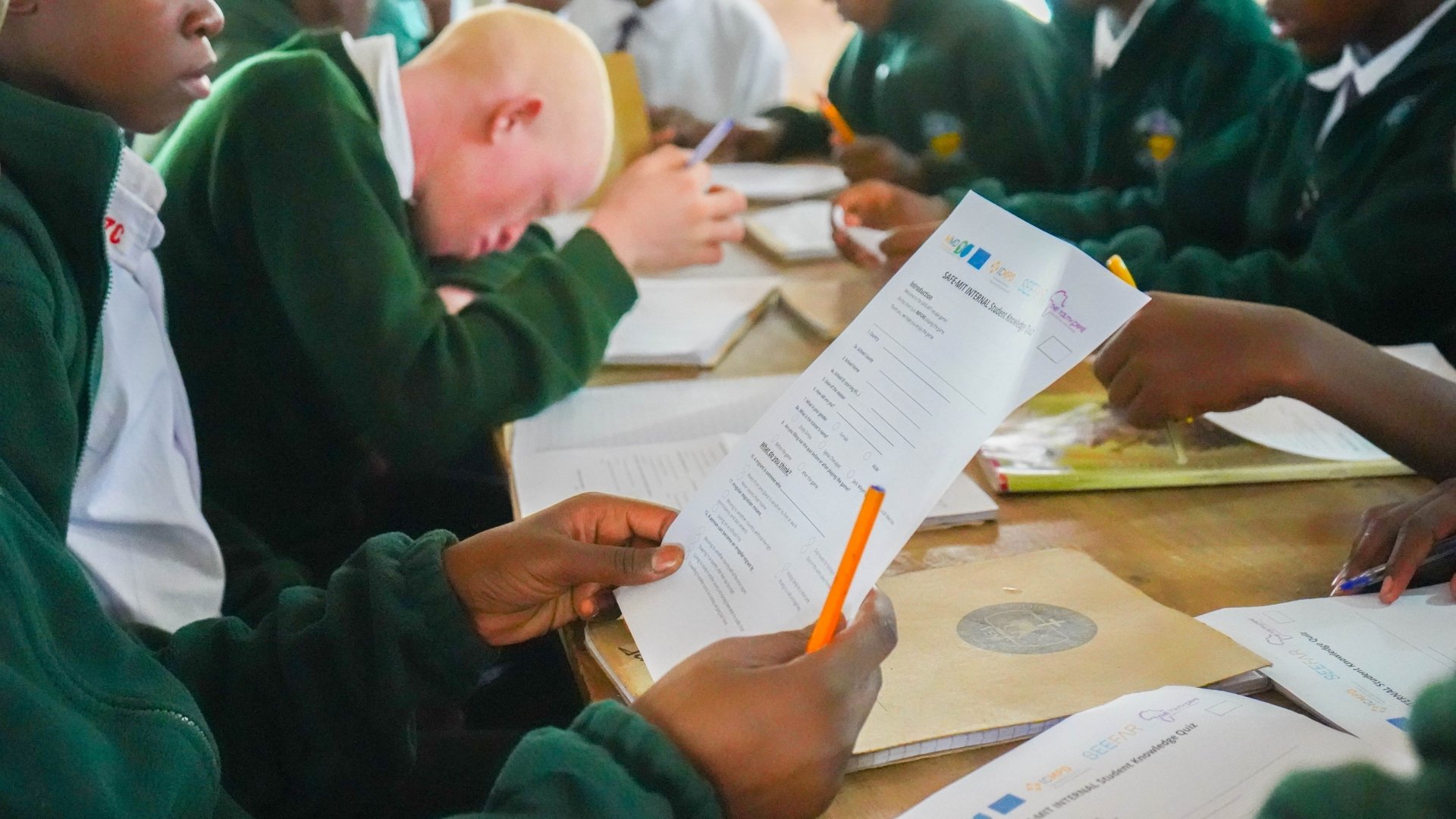
Monitoring tools (pre- and post-session forms)
These materials ensured that learning was interactive, practical, and engaging.
Phase 8: In-School Sessions – Delivering Impact
Following training and distribution, the project moved into in-school sessions.
Delivered jointly by trained teachers and Education Outreach Officers
Target group: students aged 13–18 years
Target reach: 4,650 learners
These sessions focused on:
Real-life scenarios
Interactive activities
Open discussions on migration decisions
This phase marked the direct impact of SAFE-MIT on students.
Phase 9: Teachers Sessions – Expanding Reach
The project is now in an ongoing phase where teachers independently conduct sessions within their schools.
Target reach: 11,600 students
Timeline: Ongoing, including upcoming school terms
This model ensures:
Sustainability
Scalability
Ownership by educators
Phase 10: Support and Monitoring – Sustaining Quality
To maintain quality and consistency, Education Outreach Officers continue to:
Conduct regular support calls with teachers
Provide guidance and technical support
Monitor progress and outcomes
This ensures continuous improvement and sustained impact.
Phase 11: Sustainability – Beyond the Project
SAFE-MIT is designed for long-term sustainability beyond the project lifecycle.
Key sustainability elements include:
Durable physical learning materials
QR codes linking to a central digital resource platform
Continued access to curriculum content
Teacher-led delivery model
This ensures that the impact continues long after initial implementation.
Conclusion
SAFE-MIT in Kenya represents a comprehensive, multi-phase approach to addressing the challenges of irregular migration among young people.
By combining:
Research and data
Institutional collaboration
Teacher empowerment
Student engagement
The project is creating lasting change in how young people understand migration and make life decisions.